Insights · 7 April 2026
Everything You Need to Know About Tuning Forks
The Little Fork That Does Wonders
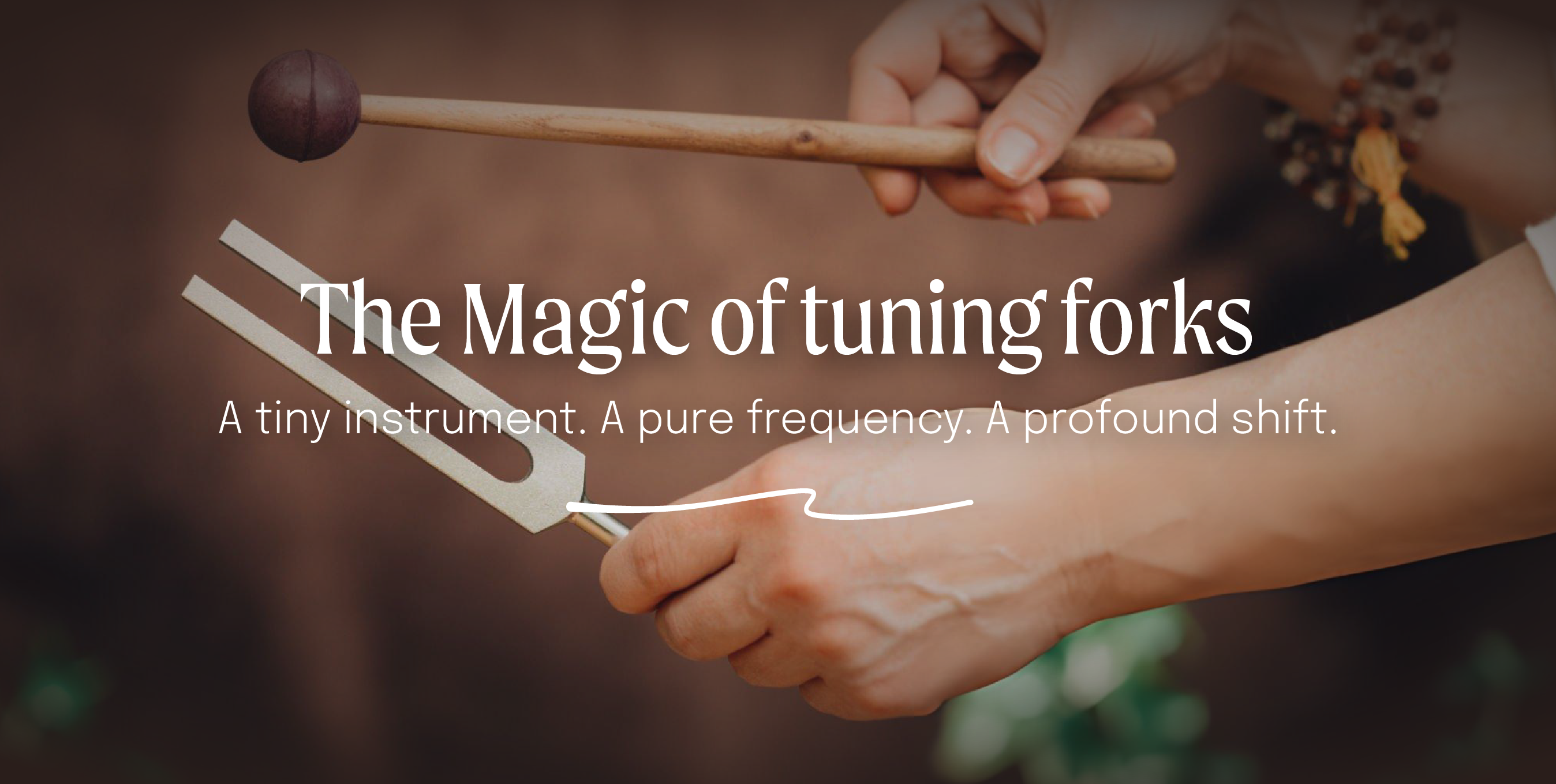
There is something almost comedic about a tuning fork at first glance. It's a Y-shape — a thin metal stick that splits into two prongs. You tap it. It hums. That's it.
And yet, this modest little instrument has been used by musicians to hold pitch, by doctors to diagnose broken bones and nerve damage, by neurologists to study the human mind, and now, increasingly, by sound healers to restore balance, ease anxiety, and help people come home to their bodies.
Tuning forks have been around since 1711. Musicians used them to hold pitch. Doctors used them to test hearing and detect fractures. And now, sound healers around the world are using them to do something quieter and just as remarkable — helping people come back to themselves.
Here's everything you need to know.
The Basics: What Even Is a Tuning Fork?
A tuning fork is a two-pronged metal instrument that, when struck, vibrates at a precise, fixed frequency. That frequency is measured in Hertz (Hz), or cycles per second. A fork tuned to 528 Hz vibrates 528 times every second, producing a single, unwavering tone.
Unlike a singing bowl or a gong, which is rich with overtones and harmonics, a tuning fork delivers one pure note. Think of it as a laser versus a street light. Both are light. One is focused.
That focus is exactly what makes tuning forks so powerful in healing work.
Why Does Vibration Heal?
It's actually quite beautiful — the science behind it.
Your body is not solid. At the cellular level, everything in you is in constant motion: oscillating, pulsing, vibrating. Every organ, every tissue, every system has its own natural frequency. When we're healthy, everything hums along in harmony. When we're stressed, depleted, or unwell, that harmony starts to fray.
Sound healing works on two principles.
Resonance
When a vibrating tuning fork is brought close to the body, your tissues respond to that frequency. Like a tuning fork that hums in sympathy when another is struck nearby, your body naturally begins to resonate with the sound.
Entrainment
Your nervous system has a profound ability to synchronise with a steady external rhythm. A predictable, calming vibration tells your body, “heyy, it's safe to relax.” Heart rate slows. Breath deepens. The brain shifts from the anxious beta-wave state into the calmer alpha and theta states associated with rest, creativity, and healing.
This is not magic — it's physics. And it's been measured.
Studies have found that exposure to specific healing frequencies can meaningfully reduce cortisol (the stress hormone), increase oxytocin (the bonding and wellbeing hormone), calm the nervous system, and support tissue regeneration at the cellular level.
What Can Tuning Forks Actually Help With?
This is where it gets practical.
Tuning forks are not a one-trick instrument. Depending on the frequency and how you use them, they can address a surprisingly wide range of physical, emotional, and mental concerns.
Stress and anxiety are the most common reasons people turn to tuning forks. The steady, predictable vibration activates the parasympathetic nervous system — the body's rest-and-digest mode — signalling the brain to stand down from high alert. Most people feel a noticeable shift within minutes.
Sleep difficulties respond well to a short tuning fork practice before bed. Chronic insomnia is often rooted in a nervous system that simply cannot switch off. A few minutes with the right frequency can do what scrolling through your phone never will.
Physical pain and tension — particularly chronic muscular tension, joint stiffness, and headaches — can be addressed directly with weighted tuning forks placed on the body. The vibration stimulates circulation, loosens held tissue, and encourages the body to release the physical armour it builds around pain.
Emotional processing is perhaps the most profound use. Grief, fear, old anger, and heartbreak are not just psychological experiences. They are stored in the body, in the tissues, and in the nervous system. Specific frequencies reach places that talking sometimes can't, and many people experience a release during a session that they have been carrying for years without realising.
For meditation and spiritual practice, tuning forks are remarkable tools for dropping in faster and going deeper.
The Frequencies and What Does Each One Do?
Not all tuning forks are the same. Different frequencies do different things, and understanding even the basics helps you work with them more intentionally.
128 Hz is the most grounded and physical of the healing frequencies. It is deeply felt in the body and used for pain, tension, bone health, and nervous system regulation. It is also widely used in medicine for neurological testing.
136.1 Hz is known as the OM frequency, mathematically corresponding to the resonant frequency of the Earth's orbit around the sun. It is deeply grounding, calming, and widely used in meditation practices worldwide.
174 Hz is the lowest of the Solfeggio tones and works primarily with physical pain and the sense of safety in the body. It is slow, deep, and profoundly settling.
285 Hz is associated with tissue regeneration and cellular healing, supporting physical recovery and vitality.
396 Hz works with liberation from fear and guilt — emotions that anchor us to the past and prevent forward movement.
417 Hz is the frequency of change. It works with breaking patterns, dissolving stagnation, and creating openings where things have felt stuck.
528 Hz is perhaps the most studied and celebrated healing frequency. Known as the Love Frequency, it is associated with the heart, DNA repair, and a deep sense of balance. Research suggests it can reduce cortisol significantly within 30 minutes while increasing oxytocin.
639 Hz works with connection and relationships — both with others and with yourself. It supports empathy, communication, and emotional healing.
741 Hz is associated with expression, clarity, and the release of emotional toxins — the frequency of speaking your truth.
852 Hz works with intuition and spiritual order, helping dissolve overthinking and reconnect you with deeper knowing.
Weighted vs Unweighted: What's the Difference?
This is one of the first questions beginners ask — and it matters.
Weighted tuning forks have small weights attached to the ends of the tines. This slows the vibration and produces a fuller, more physically felt tone. They are designed to be placed directly on the body — on joints, muscles, pressure points, and along the spine. If you are working with physical pain, tension, or grounding, weighted forks are your tool.
Unweighted tuning forks are lighter, produce a clearer and higher tone, and are used around the body rather than on it — near the ears, above energy centres, or moved through the energy field. They are better suited for emotional healing, mental clarity, meditation, and working with the biofield.
The simple rule: weighted forks work with the body; unweighted forks work with the field.
How to Actually Use One?
Hold the fork by the stem — never by the tines — as this immediately dampens the vibration.
Strike one tine gently against a rubber mallet, a silicone activator, or the heel of your palm. Never strike against a hard surface, as it damages the fork and distorts the frequency.
You will feel light vibrations through the stem and hear a clear, steady tone begin. That tone is your frequency.
For weighted forks, press the stem gently onto the area of the body you are working with — the sternum, a joint, the base of the skull, or the soles of the feet. Hold it in place and feel the vibration travel through the tissue. Release and repeat.
For unweighted forks, hold the vibrating fork 2–5 centimetres from each ear and let the sound move through you. You can also hover it slowly over different areas of the body or move it through the space around you from head to feet.
Drink water after a session. Vibration moves energy through the body, and water helps the system process what has shifted. If emotion surfaces, let it. That is the fork doing its job.
How to Know Which Frequency You Need?
If you are just starting out and want a single fork, 128 Hz is the most universally recommended for physical work, while 528 Hz is beloved for emotional and general healing. Between the two, you cover a vast amount of ground.
If you want two forks, practitioners often recommend pairing C (256 Hz) and G (384 Hz), a musical interval known as a perfect fifth. Struck together, they create one of the most deeply harmonising sounds in existence and are used by healers at the start of nearly every session.
They are also available in sets. The 7 Chakra Set gives one fork for each energy centre of the body — a complete system for daily practice. The Solfeggio Set brings together the full range of ancient healing tones, from 174 Hz to 852 Hz, ensuring you always have the right frequency for whatever you're moving through.
The Bigger Picture
There is an experiment by Jean-Martin Charcot, the founder of modern neurology, exploring whether tuning fork vibration could shift neurological states. It could.
That thread — sound as medicine — runs through nearly every ancient healing tradition on Earth. Egyptian, Indian, Greek, Chinese, Indigenous — all used sound to restore what they understood as the harmony of the living system. The instruments were different. The understanding was the same.
Modern science is catching up. Deep brain stimulation uses precisely targeted vibration to reduce Parkinson's tremors. Ultrasound breaks up kidney stones. Low-frequency vibration is being studied for bone density and tissue regeneration.
The gap between sound healing and mainstream medicine is far narrower than it appears.
The tuning fork sits quietly at the centre of all of this — small, simple, and profoundly effective. 🙂
Tags:
- Tuning Fork Sound Therapy
Checking session…
…
Related Insights
View All
Consonance and Dissonance the two Pillars of Sound
Consonance, Dissonance and how it facilitates deep psychological shifts A “clash” in sound is not just something heard in the ears, it is processed in the mind and felt in the nervous system. Healing through sound rests…
Breathwork Basics Every Sound Practitioner Should Know
The Use of Pranayama in Sound Bath Sessions As sound healers, we work with vibrations, breath, emotional states, and subtle shifts in human energy. Our instruments may be the external tools, but the first gateway to…