

Insights · 7 August 2025
Everything You Need to Know About Handpans
Do you feel something stir within you when you hear the captivating sound of a handpan? You're not alone. The handpan is renowned for its unique, ethereal tones—a meditative and angelic melody that seems to transport you into another state of being.
But before you dream of owning one, have you ever wondered?

- How are handpans made?
- What materials give them their distinct sound?
- What scale should you choose?
- How do you care for them?
- And how do Sarveda’s handpans stand out?
A Brief History of the Handpan
The handpan was invented in 2000 by Felix Rohner and Sabina Schärer of PANArt in Switzerland. Drawing inspiration from the Trinidadian steelpan, the Indian ghatam, and other global percussion instruments, they created the Hang—a new instrument made from various alloy steel, played with the hands, and designed for melodic, meditative sound. Due to high demand and limited availability, other makers around the world began crafting similar instruments, which came to be known as handpans. Today, handpans are made globally and are used in music, meditation, therapy, and sound healing.Structure of the Handpan
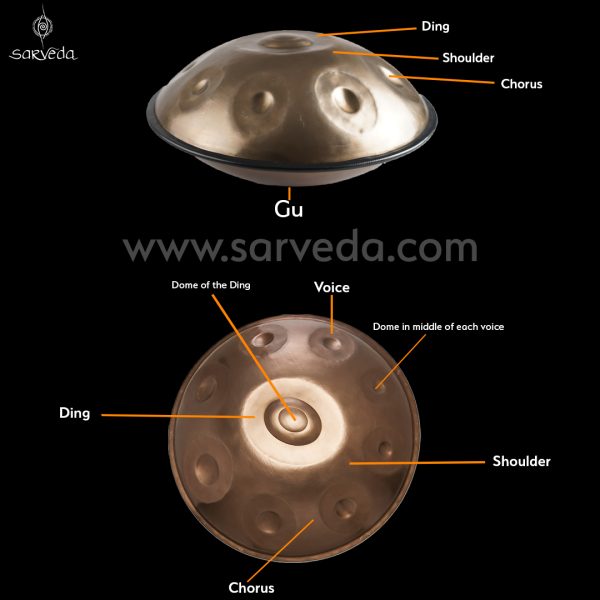
A handpan is made of two steel shells fused together. The top shell features a central dome known as the Ding, which provides the root note. Surrounding it are 7–10 tone fields, each precisely hammered to create specific pitches. The bottom shell—called the Gu side—has a resonating hole that amplifies the sound and sometimes carries additional tuned notes. This UFO-like shape isn’t just aesthetic—it’s essential to the instrument’s resonance, sustain, and warmth.
Why our Handpans Are Different?
At Sarveda, we’ve worked closely with expert Indian artisans to develop handpans that are not only visually beautiful but optimized for durability, tone, and ease of use.Sound & Playability
- Tuned to ±10 cents for accurate pitch and enchanting resonance.
- Rich and wholesome—ideal for meditation, yoga, and intuitive music.
- Excellent for melodic flow or percussive play.
- Expand your playability with advanced percussive and slap techniques.
- Compatible with other instruments and scales.
Build & Durability
- Rust-Resistant Stainless Steel: Maintenance-free and weather-friendly.
- Heat Stabilized: Reliable tuning in all climates.
- 1.2mm Steel Shells: Balanced thickness for clarity, resonance, and ruggedness.
- Weight: 4.5 kg
- Dimensions: 56 cm diameter × 28 cm height
Accessories & Support
-
- Soft Bags: Best for local travel, offering padding and easy carrying.
- Hard Cases: Essential for air travel and maximum protection against impact.
- Tripod Stands: Offer adjustable height for playing while seated or standing, and allow for better resonance.
- Tabletop Stands: Simple rings that lift the handpan for improved sound on a flat surface.
Choosing the Right Handpan Scale
Since handpans are non-chromatic, each instrument plays in a specific scale. Here are some scale suggestions:- D Kurd: Great for emotional, versatile music. Recommended for beginners and intermediate players.
- D Celtic Minor: Bright and intuitive, ideal for spontaneous and melodic playing.
How Handpans Are Made?
Creating a handpan is a time-intensive art. The process includes:- Shaping flat steel into domes via hydroforming or hammering.
- Strengthening the steel and enhancing tonal properties.
- Carefully laying out and dimpling each note zone.
- The most time-consuming step—up to 72 hours of meticulous hammering for each instrument.
- The two shells are fused, fine-tuned, and checked for tonal consistency.
Maintenance & Care Tips
Thanks to our rust-resistant stainless steel, Sarveda handpans are mostly maintenance-free. Still, for best results:- Wipe after use with a soft, dry cloth.
- Avoid moisture and do not leave it in a closed case long-term.
- Store in a dry, shaded space.
- For humid climates, optional oiling every 1–2 months can be done with coconut oil or isopropyl alcohol—but it’s generally not required.
Travel Tips for Your Handpan
Yes—you can fly with your handpan! Here's how to do it safely:- Every Sarveda handpan comes with a padded soft case. For frequent flyers, consider upgrading to a hardcase like Evatek, Panji Bag, or AVAYA.
- Our 56 cm models fit in most overhead bins. Always board early to secure space.
- Explain it’s a fragile musical instrument. Most staff are curious and respectful!
- Unless you have a hardcase and no other option. Use plastic wrap for added protection.
- Pack soft clothes inside your handpan case (away from the note fields) to save space.
Conclusion
The handpan is more than just an instrument—it's a tool for transformation. Whether you’re playing to calm the mind, explore rhythm, or facilitate healing, your handpan should resonate with your soul and lifestyle.Take your time to explore, listen, and choose wisely:)
Tags:
- Sound Healing
Checking session…
…
Related Insights
View All
Everything You Need to Know About Tuning Forks
The Little Fork That Does Wonders There is something almost comedic about a tuning fork at first glance. It's a Y-shape — a thin metal stick that splits into two prongs. You tap it. It hums. That's it. And yet, this…
Consonance and Dissonance the two Pillars of Sound
Consonance, Dissonance and how it facilitates deep psychological shifts A “clash” in sound is not just something heard in the ears, it is processed in the mind and felt in the nervous system. Healing through sound rests…