Insights · 27 November 2025
Breathwork Basics Every Sound Practitioner Should Know
The Use of Pranayama in Sound Bath Sessions
As sound healers, we work with vibrations, breath, emotional states, and subtle shifts in human energy. Our instruments may be the external tools, but the first gateway to healing always begins inside the body, with the breath. Before a participant receives any sound, their nervous system must feel safe, open, and grounded. This is where pranayama becomes invaluable. Breathwork helps balance the autonomic nervous system, creating the ideal internal space for a sound bath to work more deeply.Understanding Nervous System Balance
The autonomic nervous system has two major branches:Sympathetic Nervous System (SNS)
The activation system. It promotes:- Alertness
- Mobilization
- Energy and readiness This is the “fight or flight” state. Many participants walk into a session already in sympathetic overdrive—tight breath, racing mind, and emotional load.
Parasympathetic Nervous System (PNS)
The relaxation system. It promotes:- Recovery
- Integration
- Rest and healing This is the “rest and digest” state. Sound healing works best when participants shift into this mode.
How Pranayama Practices Deepen the Sound Bath Experience
To understand why these practices matter, it helps to look at how the nervous system influences a person’s ability to relax. When the sympathetic nervous system is active, the body enters a fight-or-flight state. Breathing becomes shallow, thoughts speed up, and the mind becomes restless. Many people walk into a sound session already carrying this stress. On the other hand, when the parasympathetic system takes over, the body shifts into a rest-and-digest mode. Breathing becomes slower, the heart rate settles, and healing becomes possible. Sound journeys work best when participants naturally move from the first state into the second, and breathwork is one of the quickest ways to guide them there. Breathwork regulates physiological responses faster than any other method. Within minutes it can:- Slow the heart rate
- Deepen the breath
- Stabilise emotional energy
- Prepare the mind for stillness
- Increase receptivity to sound frequencies
Types of Pranayama and Their Effects on the Body
Below is an easy-to-understand list categorising pranayamas based on their influence on the nervous system.Activating (Sympathetic-Supportive) Pranayamas
These build heat, enhance alertness, and clear mental fog. Kapalbhati Short, forceful exhalations stimulate energy, release stagnation, and awaken the mind. Bhastrika Bellows breathing increases circulation and respiratory capacity—great for energising participants before a session. Surya Bhedana Right-nostril breathing activates the pingala nadi, supporting focus and alertness. Use in sound baths: Helpful at the start of a session to clear sluggishness or when participants arrive dull, tense, or heavy.Balancing (Harmonising) Pranayamas
These help synchronise both branches of the nervous system. Nadi Shodhana (Alternate Nostril Breathing) Balances left and right brain hemispheres, stabilises emotional energy, and prepares the mind for meditative receptivity. Samavritti (Equal Ratio Breath) Equalising the inhale and exhale brings immediate rhythmic balance to the nervous system. Ujjayi Breath Creates gentle sound in the throat, grounding the mind while maintaining alertness. Use in sound baths: Ideal as a transition phase—after activation and before deep relaxation.Relaxing (Parasympathetic-Enhancing) Pranayamas
These soothe the mind, slow the breath, and activate the vagus nerve. Bhramari The humming vibration calms the nervous system, reduces anxiety, and prepares the body for deep rest. Chandra Bhedana Left-nostril breathing cools emotional heat and induces relaxation. Long Exhale Breathing Extending the exhale signals the parasympathetic system to switch on. Use in sound baths: Perfect just before starting the sound journey or as a closing integration practice.Comparing Activating vs Relaxing Breathwork
Using Kapalbhati and Bhramari as an example: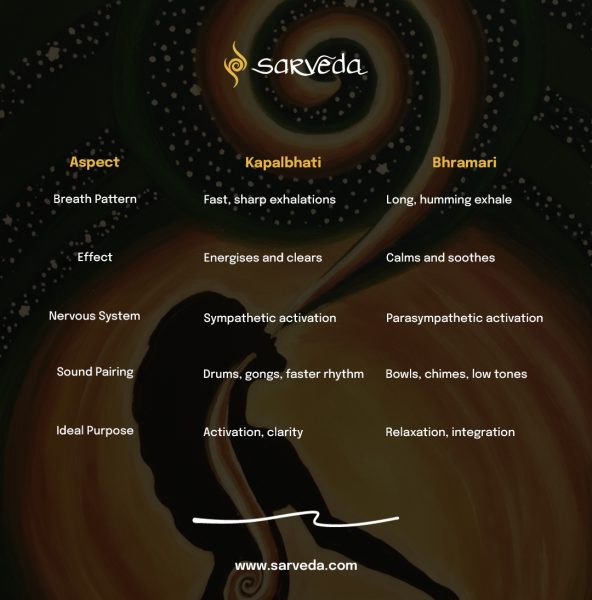 But similar contrasts exist across all breath practices. Understanding these differences lets a sound healer guide participants more intentionally.
Integrating Pranayama in a Sound Bath Session
A simple way to include these breath practices is by weaving them naturally into the structure of your session. You can begin by welcoming participants and inviting the group to observe their natural breath for a minute, allowing their bodies to settle. Then introduce Activating pranayama slowly, guiding them through 20 to 30 gentle strokes followed by a short pause. After a moment of silence, transition into a balancing and relaxing state. Encourage them to hum softly, feeling the vibration inside their own body. The shift from the sharpness to the sweetness creates a beautiful inner journey even before the instruments begin. Once the breathwork settles, you can smoothly enter the sound journey—starting with softer tones and gradually expanding into deeper layers. Because the participants are already in a receptive state, the sound tends to travel more meaningfully through their system. Many practitioners also like to close the session with one or two rounds of gentle breathing, helping participants integrate the experience and come back to their bodies with awareness. Integrating these techniques requires presence and sensitivity. Always guide slowly, demonstrate clearly, and remind participants to stop if they feel dizzy or uncomfortable. Offer simple alternatives like slow breathing or gentle humming. More than perfection, what matters is the feeling of safety and permission you create in the room. For example A simple and effective flow looks like this: 1. Begin with awareness Have participants notice their natural breath without changing anything. 2. Light activation (optional) Use Kapalbhati or Bhastrika for 20–30 strokes to clear restlessness. 3. Move into balancing Guide them into gentle Nadi Shodhana or equal-ratio breath to stabilise the system. 4. Lead into rest Introduce Bhramari with soft humming, creating internal vibration that prepares the body for the incoming sound. 5. Begin the sound bath Start with softer tones—bowls, chimes—allowing breath and vibration to work together. 6. Close with relaxation Use 1–2 rounds of Bhramari or simple long exhalations to help integrate the experience.Why This Matters for Sound Healers
Pranayama makes the participant an active part of their healing journey rather than a passive receiver. When the breath prepares the body, sound travels deeper, emotions release more safely, and the overall experience becomes richer and more grounded. By understanding the balance between sympathetic activation and parasympathetic relaxation, sound healers can design sessions that gently guide participants through a meaningful internal shift, even before the first instrument is played.Tags:
- How Breathwork Deepens Your Sound Bath Experience
Checking session…
…
Related Insights
View All
Everything You Need to Know About Tuning Forks
The Little Fork That Does Wonders There is something almost comedic about a tuning fork at first glance. It's a Y-shape — a thin metal stick that splits into two prongs. You tap it. It hums. That's it. And yet, this…
Consonance and Dissonance the two Pillars of Sound
Consonance, Dissonance and how it facilitates deep psychological shifts A “clash” in sound is not just something heard in the ears, it is processed in the mind and felt in the nervous system. Healing through sound rests…