Insights · 18 March 2026
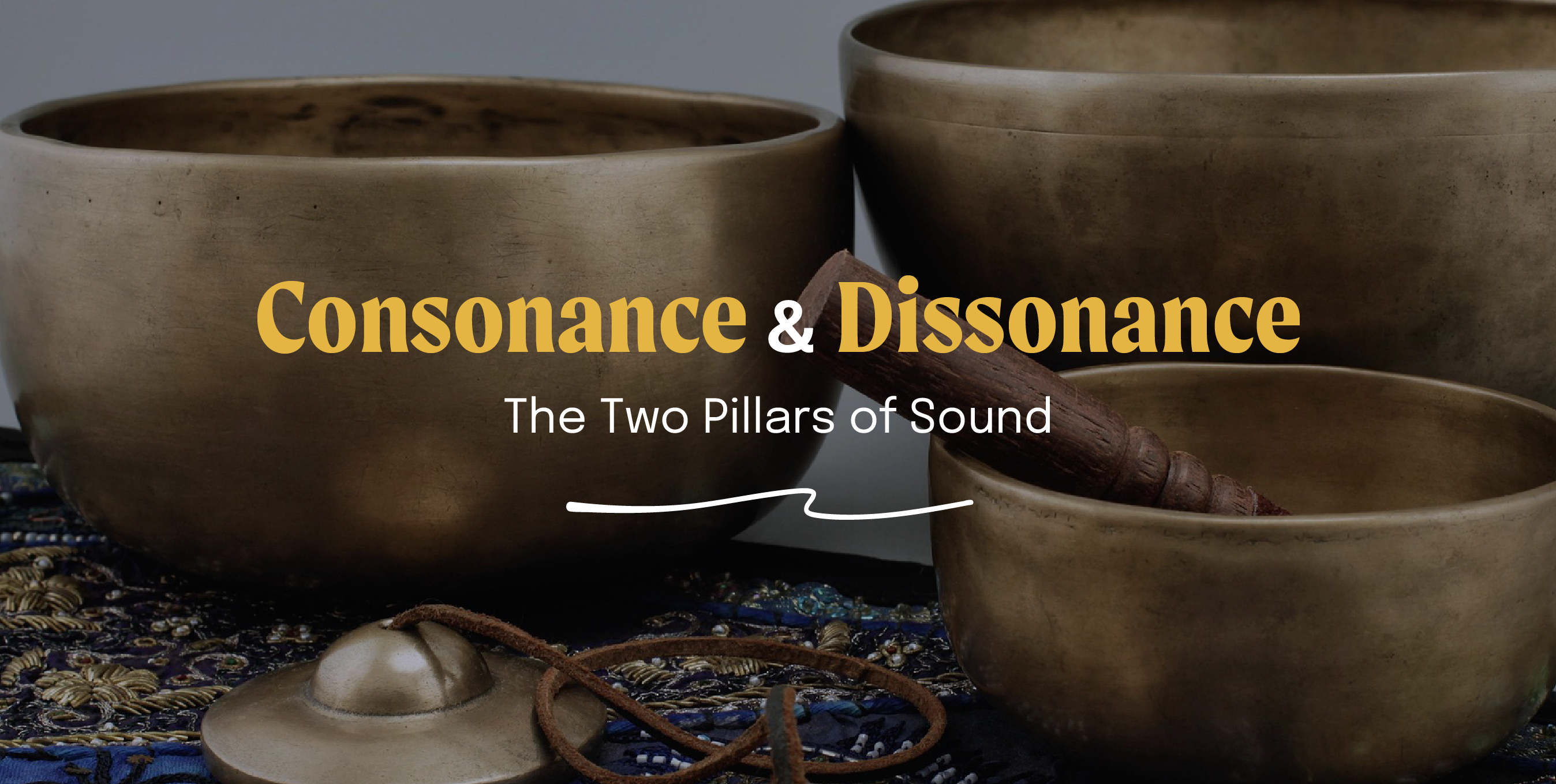
Consonance and Dissonance the two Pillars of Sound
Consonance, Dissonance and how it facilitates deep psychological shifts
A “clash” in sound is not just something heard in the ears, it is processed in the mind and felt in the nervous system. Healing through sound rests on two pillars, consonance and dissonance. One creates safety. The other creates movement. Both are essential.Consonance
Consonance is the sweet spot in sound. It occurs when notes vibrate together in simple, harmonious ratios — when their frequencies align rather than compete. Instead of friction, there is agreement. Instead of tension, there is coherence.
The Mathematics of the Sweet Spot
More than 2,500 years ago, the Greek philosopher Pythagoras explored why certain notes sound harmonious. Using an instrument called the monochord, he discovered that when a string is divided into simple whole-number ratios, pleasant intervals appear.
For example, dividing the string in half produces an octave (2:1), and dividing it into thirds produces a fifth (3:2). He realized that harmonious sounds follow simple mathematical relationships. Every note also contains higher tones called harmonics, which are naturally related to the main note through these same ratios. Because of this order, consonant sounds feel stable, peaceful, and resolved. The nervous system experiences them as safetythe “sweet spot” of sound.
The Universe as Harmonic Architecture
Pythagoras did not see these ratios as limited to music. He observed them in art, architecture, planetary motion, and natural form. He famously suggested that if one studied the monochord deeply enough, one would understand the secrets of the universe.Centuries later, German researcher Hans Kayser expanded on this idea, proposing that harmonic ratios appear in chemistry, crystallography, astronomy, botany, and physics. The same numerical relationships found in music appear in atoms, shells, leaves, and planetary orbits. Ancient cultures understood that when sound aligns with natural proportion, it reorganizes the human system.
Dissonance: The Catalyst of Change
Dissonance is a complex vibration where frequencies rub against each other. This creates beating patterns in the air- subtle pulsations that feel tense or unstable. The nervous system does not interpret dissonance as “wrong.” It interprets it as stimulation. Dissonance: ● Interrupts stagnation ● Increases awareness ● Activates the nervous system ● Brings buried emotion to the surface A clash is not just acoustic- it is psychological. The mind instinctively seeks resolution. Dissonance isn’t an enemy, but an invitation. By sitting in the "clash," the mind is prompted to seek a new, higher level of internal alignment.Without tension, nothing shifts.
Ancient Traditions and the Purpose of Intensity
Traditional healing systems understood the power of controlled intensity. In the ritual sounds of Tibetan Bon practices and the piercing icaros of the Shipibo-Conibo healers, sound was not always gentle or “pretty.” Metallic cymbals, Overtone chanting, Sharp penetrating vocal tones were used. These were used deliberately to: ● Clear obstruction ● Disrupt intrusive energies ● Reorganize imbalance In traditional medicine work, sound was used to “stir the mud.” But stirring alone was not the goal. The resolution was.
From Clash to Harmony
Once the mud is stirred, the most therapeutic moment is the return to consonance. Moving from tension back into harmonic alignment teaches the nervous system resilience. It becomes a rehearsal for life itself: activation followed by integration. In sound healing, the responsibility is not to overwhelm with intensity, but to sense capacity. Dissonance must be held, guided, and resolved. Only then does it become medicine.
When and How to Be Careful
Sound interacts directly with the nervous system. Not every body has the same capacity for activation. Use particular care with individuals experiencing: ● Acute trauma or PTSD ● Severe anxiety ● Sensory overload or neurodivergent sensitivity ● Fragile emotional states such as grief or shock These clients often need the predictability and safety of consonance first.
The Guiding Principle for Practitioners
First create safety. Then build capacity. Only then introduce tension- gradually and consciously. In practice: ● Begin with grounding tones ● Establish rhythmic predictability ● Build trust in the space ● Observe breath and body cues ● Introduce mild tension briefly ● Always resolve into consonance Intensity without containment can destabilize someone. Dissonance is not inherently healing. It becomes healing when the nervous system can process and integrate it. One soothes, One stirs. Together, they create transformation. And in the conscious dance between the two, sound becomes not just music- but medicine.
Tags:
- Consonance And Dissonance In Sound Healing
Checking session…
…
Related Insights
View All
Everything You Need to Know About Tuning Forks
The Little Fork That Does Wonders There is something almost comedic about a tuning fork at first glance. It's a Y-shape — a thin metal stick that splits into two prongs. You tap it. It hums. That's it. And yet, this…
Breathwork Basics Every Sound Practitioner Should Know
The Use of Pranayama in Sound Bath Sessions As sound healers, we work with vibrations, breath, emotional states, and subtle shifts in human energy. Our instruments may be the external tools, but the first gateway to…